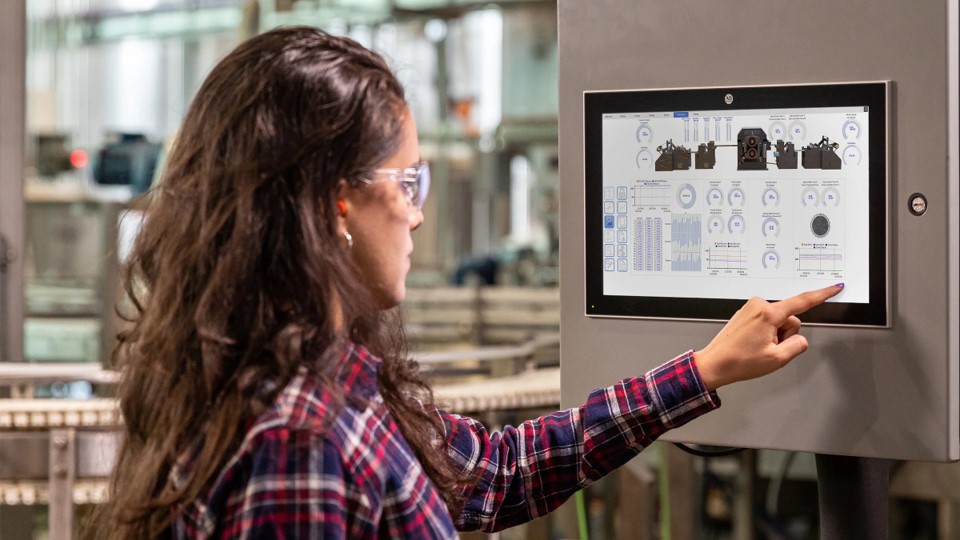
In today's digital climate, organizations are increasingly required to leverage new technologies to optimize operations and increase business agility. The goal of a human-machine interface (HMI) is to create an intuitive, accessible interface that is easily understood by operators. HMIs can be designed to enhance flexibility, increase productivity, and facilitate troubleshooting.
Designers need HMI tools that help them quickly create solutions and offer operators ways to visualize production-line data, while making it accessible throughout the enterprise. How do visualization software and HMI technology support digital transformation?
1 Empowering Digital Transformation with Modern HMIs
Technological advancements have played a significant role in the evolution of HMIs. As a result, we've seen more user-friendly touch interfaces and improved data access. The most recent advancement is the integration of HMIs with automation systems and the Industrial Internet of Things (IIoT). This integration enables enhanced machine-to-machine communication, remote monitoring, and overall control.
In the future, artificial intelligence (AI) and machine learning (ML) will be seamlessly integrated into HMIs. Smart devices and applications will anticipate user needs, adapt to their preferences, and improve the user experience based on data analysis. With the development of the IIoT, HMIs will play a vital role in managing and controlling interconnected devices, providing a unified and holistic user experience.
2 Moving towards a more connected future
Technology and automation are defining a new generation of manufacturing, where new tools will benefit all employees.
The ability to use data for real-time decision making starts with visualization built on interoperability and openness that's so easy to use that your operators can get started right away with the HMI automatically presented in their preferred language, regional settings, and date and time format and style.
For example, with FactoryTalk® Optix™ from Rockwell Automation®, HMI developers can provide operators with an intuitive user experience that minimizes the need for training.
With FactoryTalk® Optix™, users benefit from:
-
Accelerate development with real-time collaboration
-
Centralized source code management with integrated code repositories hosted in the cloud or on-premises
-
HMI visibility from anywhere
-
Access design tools via a web browser
-
Remote deployment of HMI applications
As programmable terminals develop, the barriers between humans and machines will be reduced, leading us to a more connected and empowered future.
3 Promoting collaborative design
Modern HMI tools provide increased efficiency. A lack of visibility can lead to difficulties tracking progress, identifying parties making changes, and understanding the reasons for those changes. New HMI software tools provide comprehensive project visibility in a collaborative design environment, enabling designers to access the timely and relevant information needed for quick and informed decision-making. HMI integration with web-based tools allows teams to develop and deploy applications remotely and seamlessly implement changes and updates to the production environment.
4 Integration with a centralized repository
Cloud-based design tools can easily integrate into a centralized repository, allowing multiple users to contribute and merge changes. This integration also helps identify and eliminate potential duplication.
Centralized integration allows teams to easily identify who made changes and access different versions of individual components and the entire application directly within the design tool. This allows HMI developers to collaborate with clients, facilitate application creation, share ideas, exchange code snippets, troubleshoot issues, and evaluate objects and demo applications using a common, centralized repository.
Another advantage of integrated HMI design tools is the creation of reusable code libraries stored in a centralized code repository. Thanks to their proven effectiveness, these code modules become a valuable resource for developers, allowing them to drag and drop them into their code blocks and build application functions on top of them.
5 Empowering Operators with Remote Access
Remote access tools for maintenance play a key role in empowering operators by enabling timely reporting of issues and notification of maintenance engineers. Depending on the complexity of the problem, it can be resolved using integrated chat, such as FactoryTalk® Remote Access™ from Rockwell Automation, where the operator describes the issue and maintenance specialists offer possible solutions. Some issues may require escalation, and with remote access in HMI tools, maintenance engineers can view the operator's screen. This interaction allows them to make necessary changes remotely. Any maintenance-related changes to the running application are saved to cloud storage, ensuring the application remains up-to-date.
6 Universal solution
A comprehensive solution like the FactoryTalk® Optix™ portfolio enables developers to optimize processes and streamline operations—from HMI hardware to software. This not only saves time but also budget when developers can integrate various processes into a single, collaborative environment.
Across many industries, people are looking for a comprehensive end-to-end HMI solution with a software platform, hardware options, and remote access that will solve all their daily problems.
A single comprehensive solution has undeniable advantages:
-
Complete visibility from start to finish of a single project
-
Reduce costs by using only one supplier
-
Consistent reliability thanks to software and hardware products designed to work together
-
Increased flexibility and scalability
-
Improving data understanding
- Improved customer experience
This material was prepared based on materials from our partner Rockwell Automation.