Proof testing - without shutdown and backup structures
Inlet valves must be tested regularly. Without a second, parallel branch, the signal branch must be shut down, limiting plant availability. This limitation on plant availability is eliminated by using a SIL 3 barrier: Since the devices are HART-transparent, partial stroke tests (PSTs) can be performed, allowing devices to be tested without the need for a parallel branch or shutting down the entire plant.The positioner operates in "discrete" mode. This means that during operation, it is either fully open or fully closed. Compared to discrete emergency shut-off valves or safety shut-off valves, this design offers the advantage that, in addition to the actual function, PSTs can now be initiated via HART signals. PSTs allow the functionality of positioners to be tested without interrupting the process. In this "discrete" mode, positioners often achieve SIL 3, although in "analog" mode, they correspond to SIL 2. The new SIL 3 barriers are the first devices on the market to provide explosion protection and include a SIL 3 shutdown function.
Reduced testing costs due to longer intervals between tests
Using Pepperl+Fuchs SIL 3 barriers not only reduces the cost of SIL 2 shutdown equipment but also reduces testing costs. Using a SIL 3 barrier instead of a SIL 2 device increases test intervals by a factor of 10, significantly reducing module testing costs.Pepperl+Fuchs SIL 3 barriers for intrinsically safe signals eliminate the need for complex redundant structures across two SIL 2 control circuits when configuring SIL 3 shutdown. Additionally, the testing effort for SIL 2 shutdown is significantly reduced.
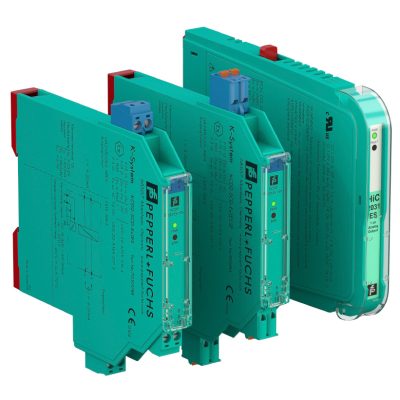
SIL 3 final shutdown - including line fault detection
The primary function of isolated barriers is to amplify the input signal from the control system to control actuators in hazardous areas. Digital signals can be superimposed on the analog measured value on the field or control side. The signals are transmitted bidirectionally (HART). Test sockets for connecting HART communicators are integrated into the device terminals.SIL 3 single-channel barriers are available for both DIN rail mounting (System K) and termination board mounting (System H). Devices for System K (KCD2-SCD-EX1.ES, KCD2-SCD-Ex1.ES.SP) are equipped with screw or spring-loaded terminals. Like the barrier for System H (HIC2031.ES), these devices feature a 12.5 mm width, line fault detection, and a separate fault output. Errors are signaled by LEDs and a separate error message. With the introduction of SIL 3 barriers for intrinsically safe signals, Pepperl+Fuchs expands its safety portfolio to cover all signal types—both digital and analog. This allows operators to obtain all the modules needed for safety-related applications from a single source.